
Serpent’s Stout
When people here the words The Lost Abbey they normally associate our production with Belgian Inspired Beers (and flavors). Stout is a curious thing as not many Belgian Stouts exist but there are numerous examples of a darker colored beer made with Roasted and Black(ish) malts and there are even some labeled as Stout. But there are not a ton of “Stouty” Belgian beers so they are more obscure in their makeup.
The origin of Stout beer traces it’s lineage back to Guinness and the numerous stout/porter styled beers of Ireland. They migrated away from Ireland and found their way throughout the British Colonies and even into the cooler weather Scandinavian Countries where some of the best Imperial Stouts are made today.
Like many beer styles a range of expression from low abv to higher abv exists. Most people don’t know it but Guinness while very dark in color is remarkably lighter in abv (under 5%) Strong Stouts adopted the word “Imperial” as part of the naming conventions and were bestowed a regal like sense of divinity and expression. Today there are basically two styles of Imperial Stout. We find a more restrained sense of alcohol and hop impression in the British Imperial Stouts. These beers range from 8-12 % abv are medium bitterness but really lean into the malt expression, depth of complexity and the overall resonence of the Roasted Barley and coffee notes it provides.
American Imperial Stout is similar in texture but this one goes to 11. Typically we find these beers to me “more.” They show an elevated contribution of hop aroma and bitterness. They might (or might not) by drier in the finish then their British Cousins and they will most assuredly be loud and proud of the resulting intensity. They are unmistakably bigger and bolder in almost every way. The best of them smell like freshly roasted coffee beans oozing with Cocoa and hints of Baker’s Chocolate. They are prized by collectors for their ability to evolve and mature into incredibly deep flavor profiles.
When looking at the style and recipe for our Imperial Stout, I wanted to lean into the more portion of the recipe and flavors. To do so, I needed to build a deep malted layer and support the roasted barley tones. We also wished to explore a silky layer so there is a large ton of wheat and oats in the base. In order to build a “more” beer, we employed a double mash for the recipe. Typically each batch of beer is made from a single mashing of the grains yielding a balance of available malt sugars.
Serpent’s Stout has always employed the double mash to cull the most dense and rich sugar components for the beer. It’s an old world method and one we think works well in the beer. The beer is a hybrid of the two styles. It leans more into American Imperial Stout territory with its intensity and elevated abv. We chose to hop it firmly but we stayed away from later additions (and dry hopping) as we felt the beer really needed a supporting hop footprint but not one that was over stated.
Some customers are saddened to find out that our yeast choice is not our Belgian House Strain. While that would surely make for a very incredibly flavorful beer, we love the way our proprietary house yeast brings Serpent’s Stout to life. It’s brewed in December each year for a January release and it has been part of our lineup for over 15 years now. The base beer has found its way into many a bourbon, brandy, rum or even tequila barrel over the years as well. It remains a very versatile beer and has always been an anchor beer in our non sour beer barrel program.
As is the case for many of our beers, the name Serpent’s Stout existed long before the artwork and vision for the label. The funny thing about this label is in its current state you can make the argument that it is one of the most biblical images we have deployed but during the original art direction, this was not the case. (Sadly, I must also state, I don’t have the renderings of the original label concept so hopefully this will all make sense. Since I can’t show the image to you).
I don’t smoke dope and I don’t know what drugs I wasn’t doing but Sean and I met about this label and it just seemed like we should try something “different” more if you will. So instead of leaning into the tried and true method of straightforward highly biblical imagery (our wheelhouse) I asked Sean to explore an art direction with a bit more allegory and license.
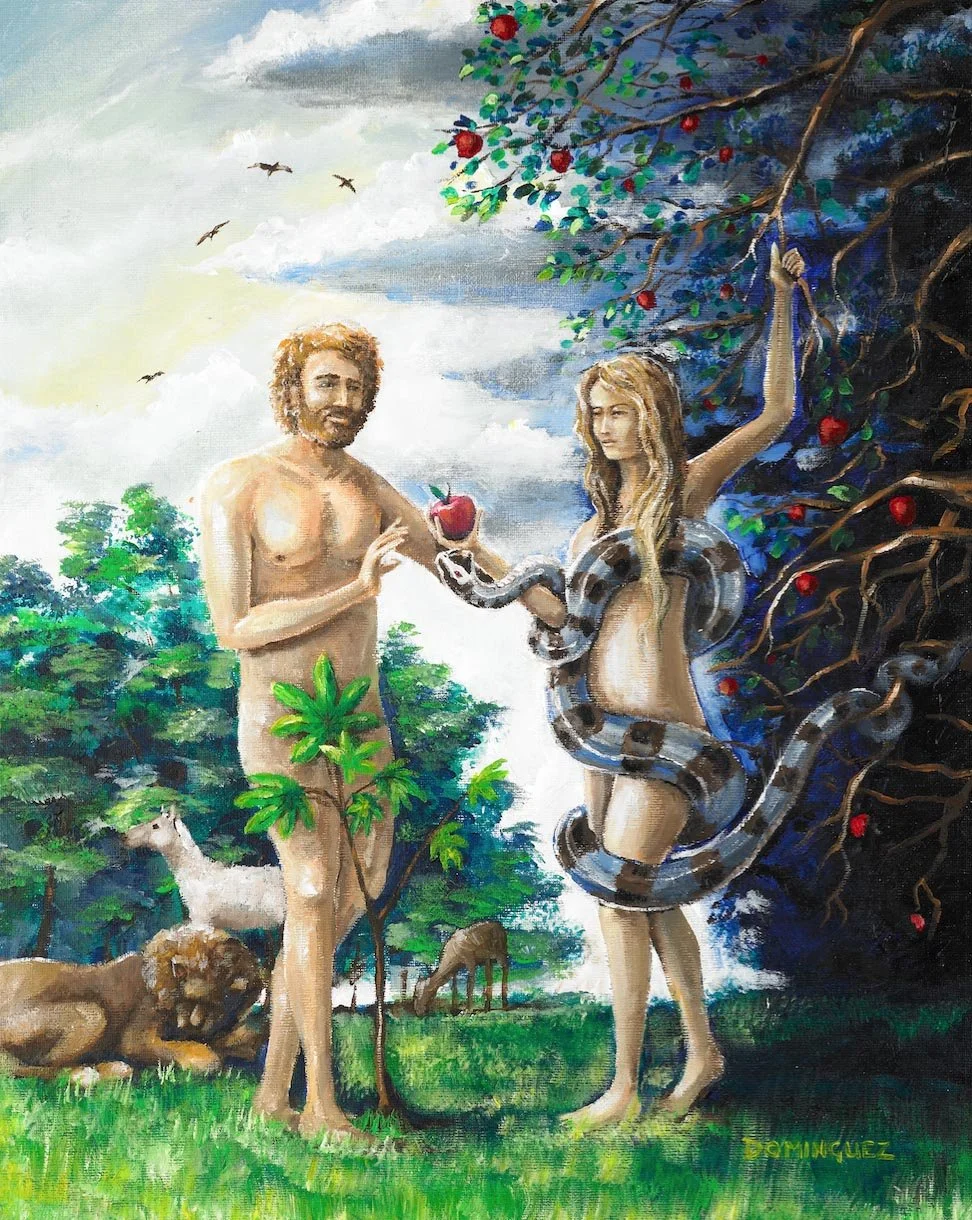
Serpents Stout original artwork by Sean Dominguez
I sat down with him and explained my vision for the label. It involved the characters from The Wizard of Oz. They would be on the yellow brick road of life (which started as a brick road and then evolved into the snakes actual tail/body/ head). As they proceeded further up the road it would become more snake like (serpent) in its appearance before ultimately shape shifting into a mountain(the head of the Serpent). Looking back on it, this whole thing feels very Harry Potter like as an image albeit one that was amateurly enacted.
Sean and I met when he came to show me the art he had conjured up. I was floored. Not because it was great mind you. I was gobsmacked for how poorly the art direction worked (in conveying the deception and deceit of the snake/serpent at work). It was a catastrophic failure and to this day the #1 worst label ideation we ever explored. It literally had Dorothy, the Scarecrow and TOTO heading out the yellow brick road in the piece. I mean why wouldn’t it? I told him that was my vision.
It was wild to see something so far off center but there I was holding it in my hand. So needless to say, I had a great chuckle and punted on that allegorical sense of good and bad and the darker side of life.
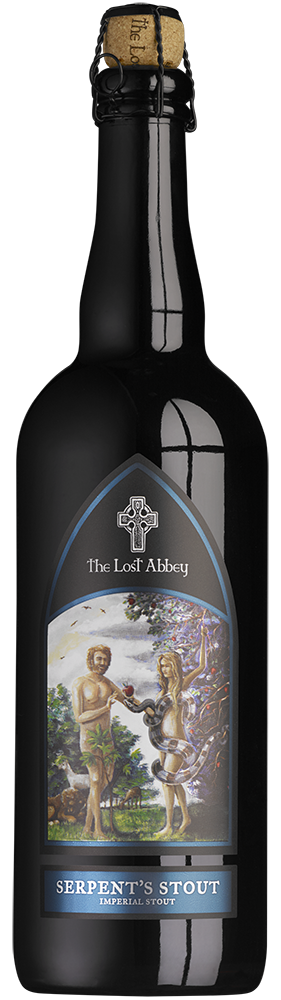
Serpents Stout Lost Abbey Bottle Artwork
We both agreed that we needed to explore the foundation story with the Devil plus Adam and Eve in the Garden. We’d focus on the Serpent, the apple and the fruit from the forbidden tree (duuh). When Sean returned with this piece of art, it was clear we had made the right choice. Serpent’s Stout has always been rooted in this biblical story and getting the art to deliver that message made sense.
I haven’t ever really shared this story but I’m quite certain that Sean must have been like WTF when he started on the painting. Bringing it to the brewery for review must have been odd. But the client is always right… I will admit we were still very early in our infancy of working together. But it’s laughable as F how this came to be AND more importantly it framed so many of the decisions I would make as the art director moving forward. Next week we’re going to chat about one of my favorite pieces of art and the only tease I will leave you with is it’s a very complex narrative.
